
Stay in Gora or Sengokuhara, the two elevated areas where Hakone's finest ryokans cluster, and yes, pay for the room with its own private open-air bath. It is the one upgrade in Hakone that changes the stay itself rather than just the view from it: no shared bathing hours to work around, no walk down a corridor in a robe, just steam rising a few steps from your futon whenever you want it. Miyanoshita, Tonosawa, Hakone-Yumoto and the shore of Lake Ashi each earn a place in a Hakone itinerary, but if the ryokan is the reason for the stop, Gora and Sengokuhara are where it is done best.
Hakone is the one chapter in a Japan itinerary where the hotel question flips. In Kyoto and Tokyo we choose a hotel for the flexibility a full day of sightseeing needs. In Hakone, the ryokan is the sightseeing: a single, deliberate night built around a hot spring bath, a kaiseki dinner served course by course in the room, and a futon laid out while you are still in the water. One night does this properly. Two or three turn a discipline into a confinement, which is why we keep the Hakone chapter short and let the rest of the route carry the pace.
At Hitotoki, we are a Japan-based team of luxury travel designers who have built more than 1,000 tailor-made journeys, and a Hakone ryokan night sits inside most of them, usually between Tokyo and Kyoto. This is the guidance we give our own clients: how the areas actually differ, what a private open-air bath changes, and how far ahead the good rooms go.
Where to stay in Hakone: quick answer
- The ryokan experience, private open-air bath rooms: Gora or Sengokuhara
- Historic charm, easiest access: Tonosawa and Hakone-Yumoto
- A ryokan over the valley, or a historic hotel instead: Miyanoshita
- The Fuji-and-lake view: Lake Ashi, as a half-day, not an overnight address
- Ideal length: one ryokan night
- Typical luxury rate: $600–1,500 per person per night, dinner and breakfast included
- Book: 9–12 months ahead for sakura and koyo, 6 months otherwise
The Best Areas to Stay in Hakone, Compared
| Area | Best for | Trade-off |
|---|---|---|
| Gora | The widest choice of ryokans with a private open-air bath | Smallest properties, first to sell out |
| Sengokuhara | Open, quiet terrain, pampas grass and art museums | No railway; a car is the easy way in |
| Miyanoshita | Hakone Ginyu's valley-view baths, or the historic Fujiya Hotel | Valley setting, Fuji hidden behind the ridges |
| Tonosawa & Hakone-Yumoto | Historic charm, the gateway town, fastest from Tokyo | Valley setting, no Fuji view |
| Lake Ashi | The shrine, the boat, the classic Fuji-and-water photograph | Very few ryokans sit directly on the water |
Gora, the Heart of the Ryokan Experience
Gora sits at the top of the Hakone Tozan Railway line, a hillside district of narrow lanes and terraced gardens where many of the region's best ryokans have built their reputations on one idea: every room gets its own bath. Gora Byakudan, small and contemporary in its design, is the property we place here most often, each room with its own open-air bath in a quiet, minimal register. Hakone Setsugetsuka, a few steps from Gora station, is built on the same idea at a larger scale.
The trade-off is the one that comes with any small, sought-after property: a handful of rooms, often fewer than twenty, and the rooms with the best baths and the best outlooks are the first to go. Gora is also home to the Hakone Open-Air Museum and the foot of the cable car up to Sounzan, where the ropeway toward Owakudani begins, so a ryokan here doubles as a convenient stop on the way up the mountain.
Sengokuhara, Open Ground and Quiet
North of Gora, the land opens into Sengokuhara, a broad, elevated plain of pampas grass and hot spring resorts with none of Gora's narrow lanes. The openness is the point: properties here spread out, with wide terraces and baths looking onto grassland and forest rather than a neighbor's roof, and the Pola Museum of Art and the Lalique Museum sit a short drive away. It is the quietest of Hakone's ryokan areas, and the one we suggest to travelers who want space more than a village around them.
Sengokuhara has no railway station, which matters only if your route depends on the Hakone Tozan Railway rather than a private car. For a one-night ryokan stay with a driver arranged for the whole day, the distance is not a real cost.
Miyanoshita, a Ryokan over the Valley or a Historic Hotel
Miyanoshita offers both answers to the Hakone question. Hakone Ginyu, one of our most frequent recommendations, has rooms stepped down the side of the gorge, each private open-air bath looking straight across the valley to the mountains opposite. A few minutes away, the Fujiya Hotel, open since 1878 and one of Japan's oldest Western-style hotels, has its own gardens, long corridors, and a history of hosting foreign dignitaries that predates most of the ryokans in this guide by decades.
We suggest the Fujiya to travelers who want Hakone's mountain air and onsen water without giving up a Western bed or a hotel's flexible hours, and to anyone combining a Hakone stop with an early departure the next morning. What it does not offer is the ryokan ritual itself, the in-room kaiseki dinner and the futon laid out while you bathe. For that, Ginyu is the reason to choose Miyanoshita.
Tonosawa and Hakone-Yumoto, the Historic Gateway
Tonosawa and Hakone-Yumoto sit in the river valley at the foot of the mountain, the first stop for anyone arriving by the Romancecar or by road from Tokyo. This is Hakone's oldest onsen ground, settled centuries before the hillside ryokans of Gora existed, and several riverside ryokans here still trace their founding to the Edo period.
The area's case is speed and character rather than scenery: Hakone-Yumoto is the transit hub, with the shops and foot-bath street that make for an easy first or last afternoon, and Tonosawa, one stop up the line, is quieter and more wooded. Neither sits at elevation, so neither offers a realistic chance of a Fuji view from the room, which is the one thing Gora and Sengokuhara have that this area does not.
Lake Ashi, the View Worth a Half-Day
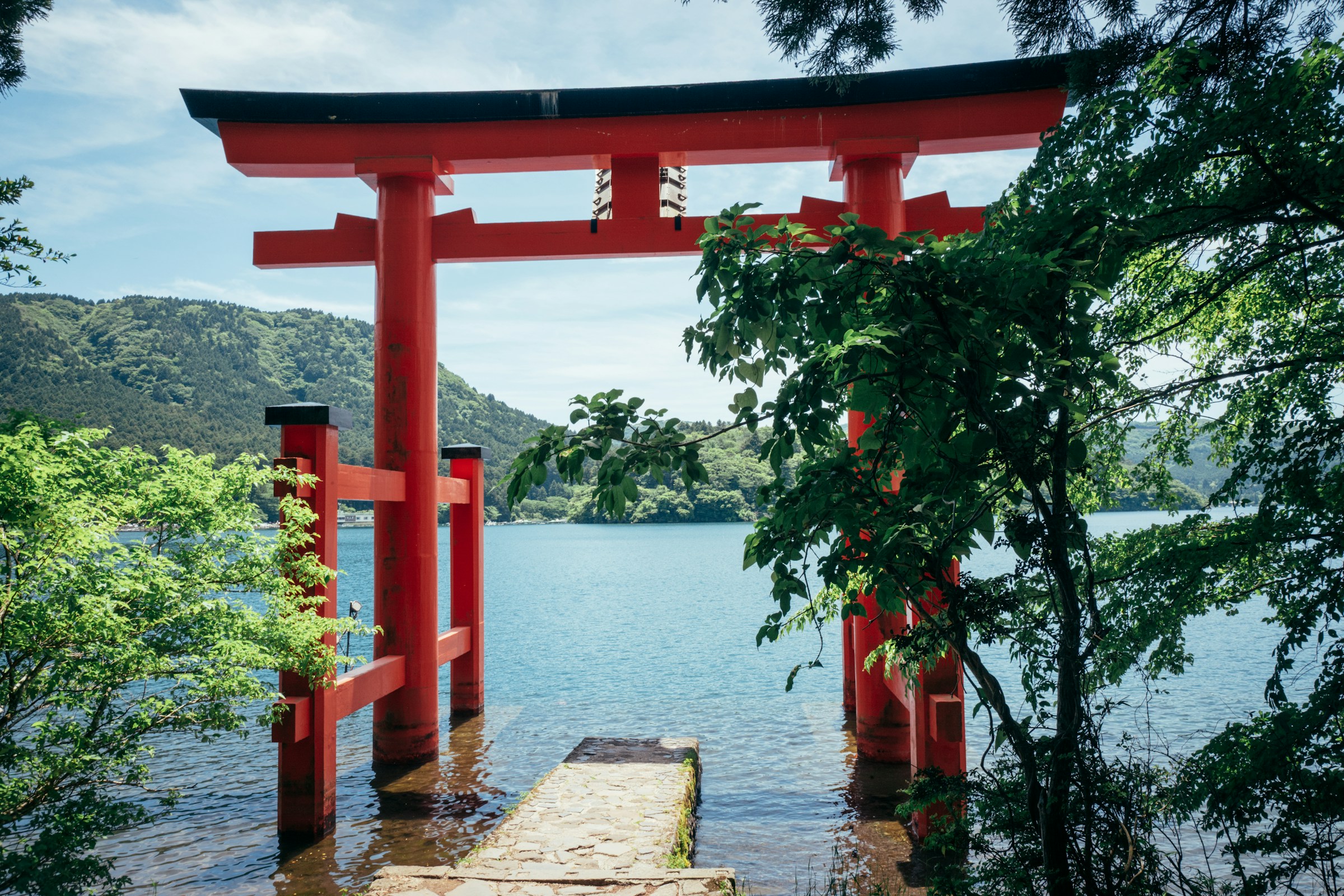
Lake Ashi is where Hakone's single most photographed moment happens: the vermilion torii of Hakone Shrine rising from the water, Mount Fuji behind it on a clear day. What the lake does not have is much in the way of true ryokans directly on the water; most lakeside lodging is larger resort-style hotels built for the view rather than for the ryokan ritual of an in-room kaiseki dinner and a private bath.
Our advice is to treat Lake Ashi as a half-day rather than an address: a morning at the shrine, a crossing by boat, a look back at the water from the ropeway, then a return to a ryokan in Gora or Sengokuhara for the night. The view is worth the detour. It is not worth giving up the better bath.
What a Private Open-Air Bath Actually Changes
A standard ryokan room in Hakone comes with access to the property's communal baths, usually separated by gender, open on a schedule, and, however beautifully designed, shared. A room with its own private open-air bath removes all three constraints at once. There is no window of hours to plan dinner around, no walk down a corridor in a yukata past other guests, and no waiting for a slot to open. You bathe before dinner, after it, or at midnight if the night is clear and you want to see the stars from the water.
It costs more, typically toward the top of Hakone's $600–1,500 per person per night range rather than the bottom of it, and for a single-night stay we think it is worth the difference almost every time. The ryokan night is already the shortest, most concentrated chapter of a Hakone itinerary; a private bath is what lets you use every hour of it on your own schedule rather than the property's.
One Ryokan Night, Not Two
The fixed rhythm that makes a ryokan extraordinary for one night, dinner at a set hour, breakfast at another, the bath built into the schedule rather than around it, is the same rhythm that becomes confining across several. We recommend one night in Hakone for a first trip. Our full ryokan guide covers what separates a great ryokan from a merely expensive one, including the booking mistakes that cost travelers their preferred dates.
The same logic that makes Kyoto and Tokyo hotel cities in our other area guides, Kyoto and Tokyo, is why Hakone carries the ryokan chapter for the whole trip rather than splitting it. One night here, a hotel everywhere else.
Getting to Hakone, and Getting Around
From central Tokyo, a private car takes about 2 hours door to door, the easiest option with luggage and the one we use for most of our clients. The scenic alternative is the Odakyu Romancecar, a dedicated express from Shinjuku to Hakone-Yumoto in about 85 minutes, with reserved panoramic seating in the front car worth requesting. Within Hakone, the Tozan Railway, the Gora cable car and the Owakudani ropeway link the valley towns to Gora and on to Lake Ashi, though a private car remains the most flexible way to move between a Sengokuhara ryokan and the sights.
Mount Fuji from a Hakone Ryokan: What to Actually Expect
Hakone sells itself on Mount Fuji more than any other destination in Japan, and the honest version of that promise is a chance, not a guarantee. From most ryokan rooms the rim of the old caldera hides the mountain; the best odds are around Lake Ashi and from the ropeway above Owakudani, and autumn and winter mornings, when the air runs driest, are when it shows itself most often. Haze and cloud hide it on plenty of other days in every season. We never promise the view when we book a Hakone ryokan; we book for the chance of it, and the hot spring bath that is there regardless of the weather.
When to Book a Hakone Ryokan
Hakone's best ryokans run a handful of rooms each, and the ones with a private open-air bath are the first to go in any season.
- Cherry blossom and autumn foliage: 9–12 months ahead. Hakone sits inside both of Japan's two busiest planning windows, and demand for the private-bath rooms outpaces everything else in the property.
- Any other season: 6 months is comfortable and leaves a real choice between areas and room categories.
Our booking timeline guide goes season by season, and the month-by-month guide to visiting Japan is the right place to start if your dates are still open. For how a Hakone night sits inside the cost of a full trip, our cost breakdown explains what drives the daily figure, and our guide to autumn in Japan and guide to winter in Japan cover how the season changes the rest of the route around it.
Three Mistakes We See in Hakone
- Booking a standard room to save money. On a single ryokan night, the private open-air bath is the difference between the trip you pictured and a nice room with a shared schedule. Spend the upgrade here rather than elsewhere.
- Staying two or three nights. The fixed rhythm that makes one night remarkable makes several confining. Keep the Hakone chapter short and move on while it still feels like a treat.
- Choosing a ryokan for the Fuji view alone. From most ryokan rooms the mountain is hidden, and even from Lake Ashi it is never a certainty. Choose the ryokan for the bath and the kaiseki first, and treat the view as the bonus it is.
Frequently Asked Questions
What is the best area to stay in Hakone for a ryokan?
Gora and Sengokuhara, the two elevated areas where Hakone's finest ryokans cluster and where private open-air bath rooms are most common. Tonosawa and Hakone-Yumoto are the historic gateway, easiest to reach and best for a short stay. Miyanoshita offers both a ryokan with private baths over the valley and Hakone's historic hotel. Lake Ashi is worth the half-day for the view, not the overnight address.
Should I book a ryokan room with a private open-air bath?
Yes, if the ryokan is the point of the trip. A private open-air bath removes the shared bathing hours and the corridor walk in a robe, and lets you bathe at your own pace, before dinner or at midnight, with nobody else's schedule involved. It costs more than a standard room, but it is the one upgrade in Hakone that changes the stay itself rather than just the view from it.
How many nights should I spend in Hakone?
One. A ryokan's fixed rhythm, dinner at a set hour, breakfast at another, is a wonderful discipline for a single evening and a confinement across several. We place one ryokan night in Hakone, usually between Tokyo and Kyoto, and build the rest of the trip around hotels with flexible hours.
Can you see Mount Fuji from a Hakone ryokan?
Rarely from the room itself, and never guaranteed. From most of Hakone's ryokan areas the rim of the old caldera stands between you and the mountain. The best odds are around Lake Ashi and from the ropeway above Owakudani, on autumn and winter mornings when the air is driest. Haze and cloud hide it on plenty of other days, which is why we never promise the view, only the chance of it.
How much does a luxury ryokan in Hakone cost?
Roughly $600 to $1,500 per person per night, with dinner and breakfast included. A room with its own private open-air bath sits toward the top of that range. A full luxury trip to Japan generally works out to $1,000 to $2,500 per person per day, excluding international flights.
How far in advance should I book a ryokan in Hakone?
Six months is comfortable for most of the year. For travel timed around cherry blossom season or autumn foliage, book 9 to 12 months ahead: Hakone's best ryokans have very few rooms, and the ones with a private open-air bath sell out first.
Choosing Your Hakone Ryokan
There is no single best ryokan in Hakone, only the right area for what you want the night to do: Gora or Sengokuhara for the private bath, Miyanoshita for a valley view or a historic hotel, Tonosawa or Hakone-Yumoto for speed and history. Fit it into a full route and it becomes one deliberate night inside a longer luxury Japan itinerary, built as a tailor-made route rather than a fixed package.
If you would like that decided by a team that lives here and knows which rooms, in which ryokans, are worth the upgrade in which season, tell us about your trip and we will build it around the right night in Hakone.
Hitotoki Travel is a luxury travel agency based in Japan, specializing in bespoke, tailor-made journeys for discerning travelers. Every itinerary is personally designed to create an unforgettable Japan experience.