
The best area to stay in Tokyo is the Imperial Palace side of Tokyo Station, Marunouchi and Otemachi, for almost any first trip. The city's leading hotels are there, the palace gardens are across the street, and everything you will leave Tokyo for, the shinkansen to Kyoto, the airport trains, the road to Hakone, starts from the same block. Ginza and Hibiya, ten minutes south, are the alternative for travelers who want the shops and the restaurants at the door. Nihonbashi, Roppongi, Aoyama and Shinjuku each make sense for a particular kind of trip, and rarely for a first one.
Tokyo asks a different question than Kyoto. In Kyoto the address decides which hours of the day you see the temples in. Tokyo has no temple district to wake up inside: it is a dozen cities joined by a railway, and you will spend your days across all of them whatever you choose. The address decides two other things, the evenings you come home to and the ease of the mornings you leave on, and those are worth getting right.
At Hitotoki, we are a Japan-based team of luxury travel designers who have built more than 1,000 tailor-made journeys, nearly all of them beginning or ending in Tokyo. This is the guidance we give our own clients: how the neighborhoods actually differ, which hotels hold the best ground in each, and how the choice fits the rest of the route.
Where to stay in Tokyo: quick answer
- First trip, everything within reach: Marunouchi and Otemachi, the palace side
- Shopping, dining and the classic Tokyo: Ginza and Hibiya
- Old merchant Tokyo, quieter and rooted: Nihonbashi
- Art, nightlife and the contemporary city: Roppongi, Toranomon and Azabudai
- A neighborhood life, design and fashion: Aoyama, Omotesando and Shibuya
- Skyline views and Shinjuku Gyoen: Shinjuku
- Ideal length: 3 nights, 4 when Tokyo opens the trip
- Typical luxury rate: $600–1,500 per room per night at the leading hotels
- Book: 9–12 months ahead for sakura and koyo, 6 months otherwise
The Best Areas to Stay in Tokyo, Compared
| Area | Best for | Trade-off |
|---|---|---|
| Marunouchi and Otemachi | First trips, the palace gardens, every departure | A business district, quiet after dark and on weekends |
| Ginza and Hibiya | Shopping, restaurant counters, Kabuki, walking | Retail streets, few grand hotels |
| Nihonbashi | Old Tokyo, craft shops, a slower pace | Little to do in the evening |
| Roppongi, Toranomon and Azabudai | Museums, nightlife, the tallest views | Towers rather than streets, far from the shinkansen |
| Aoyama, Omotesando and Shibuya | Design, fashion, parks, a neighborhood feel | Small properties, less service infrastructure |
| Shinjuku | Skyline views, the Gyoen garden, the west side | The busiest station in the world at the door |
Marunouchi and Otemachi, the Best Area for a First Trip
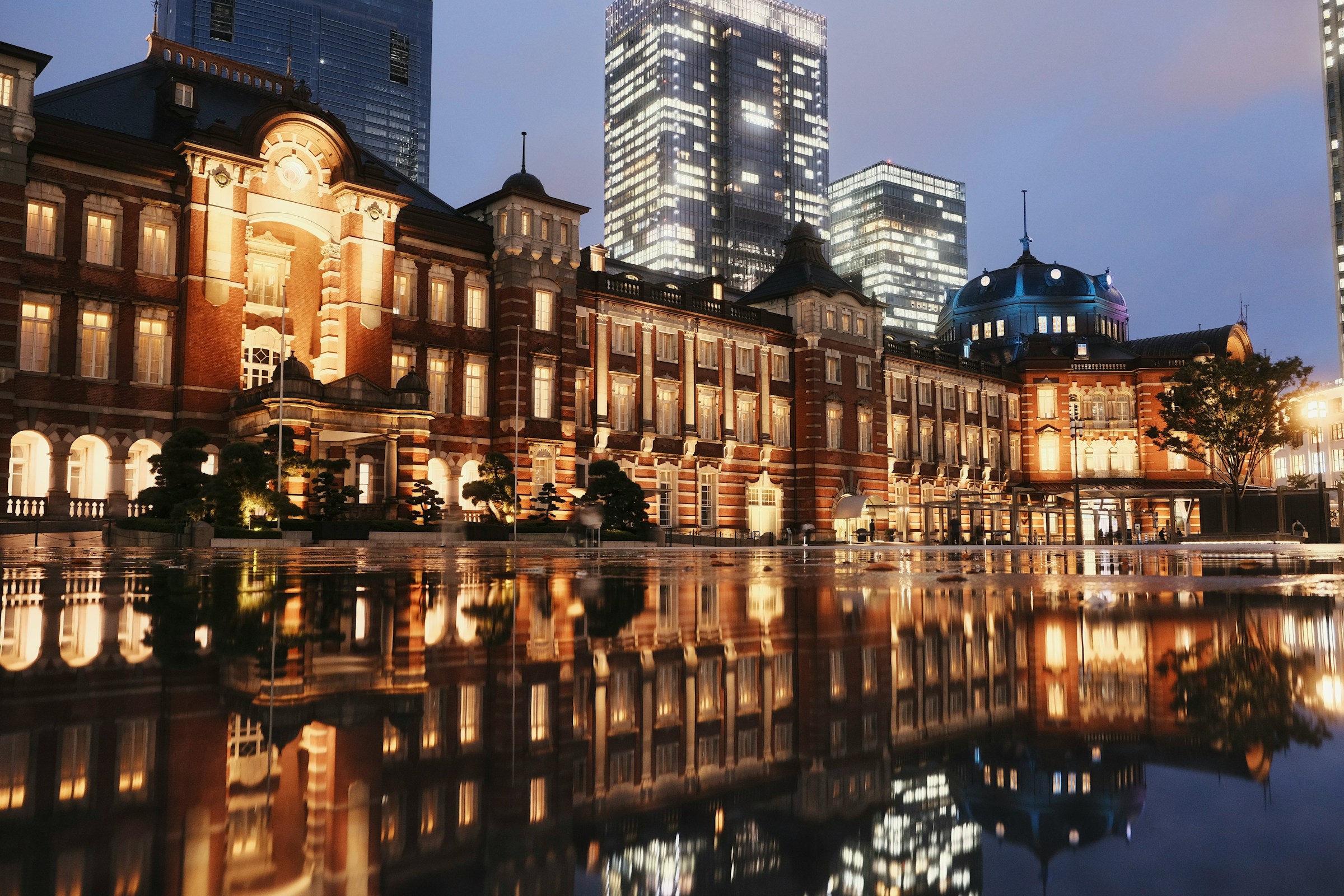
Marunouchi is the district between Tokyo Station and the Imperial Palace moat, and Otemachi is its northern half. On the map it is the center of the city; in practice it is the center of the trip. The shinkansen to Kyoto leaves from the station at your back, the Narita and Haneda trains stop there too, and the car to Hakone picks you up at the door without crossing the city first.
The leading addresses are here for the same reason. Aman Tokyo occupies the top six floors of the Otemachi Tower, with rooms looking down on the palace grounds and, on a clear winter morning, out to Mount Fuji. Palace Hotel Tokyo sits directly on the moat, the only hotel in the city with the palace gardens at eye level rather than far below. Four Seasons Hotel Tokyo at Otemachi looks at the same view from higher up, and Four Seasons Hotel Tokyo at Marunouchi, a few dozen rooms beside the station, is the quietest of the group, the kind of small hotel that knows your name by the second morning.
The first morning belongs to the palace. The East Gardens open to the public and are nearly empty at nine; the five-kilometer loop around the moat is where Tokyo runs before work. Both are across the street, which matters more on the morning after a long-haul flight than any list of attractions.
The trade-off is the district's own character. Marunouchi is where Tokyo works: it fills with suits on weekday mornings and empties on weekday nights and weekends, and the restaurants are inside the towers rather than along the streets. Ginza is a ten-minute walk for the evenings; for anything with more life, you take a taxi.
Ginza and Hibiya, the Classic Tokyo
Ginza is the district most travelers picture when they think of Tokyo at night: the department stores, the flagship boutiques on Chuo-dori, the Kabuki-za theater, and, behind them, the small lanes of counters where much of the city's best cooking happens behind a door with no sign. Hibiya, on its western edge, is the park and the palace gardens; Yaesu, on its eastern edge, is the back of Tokyo Station.
The Peninsula Tokyo stands at the corner where Ginza meets Hibiya Park, facing the palace's outer gardens, a location that puts the shops on one side and the trees on the other. Bulgari Hotel Tokyo took the top floors of a tower above the Yaesu side of the station, a few minutes from both Ginza and the shinkansen platforms. The Tokyo Edition, Ginza is the district's newer, smaller address, on a side street a short walk from the Kabuki-za. The Imperial Hotel, in Hibiya since 1890, is the grand old name of the group.
Ginza is the answer for travelers who want to walk out of the lobby into the city rather than into a taxi, and for anyone whose Tokyo is built around food and shopping. The honest caution is that Ginza's streets belong to retail: they are handsome and lively, and they close at eight. The lanes behind them do not, which is where the district earns its evenings.
Nihonbashi, the Old Merchant City
Nihonbashi is where Tokyo began as a commercial city, and the bridge that gives the district its name is still the point from which every road distance in Japan is measured. The area kept its merchants: the original Mitsukoshi, knife-makers and paper shops in business for centuries, the food halls under the Coredo towers, and the small streets of Ningyocho behind them.
Mandarin Oriental, Tokyo is the reason to stay here, on the upper floors of the Nihonbashi Mitsui Tower, with the best spa on this side of the city and views that take in both the palace and, on the other side, the river. It is a ten-minute walk from Tokyo Station, so it shares Marunouchi's logistics with more character at street level.
We recommend Nihonbashi to repeat visitors and to travelers who want a slower Tokyo. What it gives up is the evening: the district is quiet after dark, and dinner means Ginza or a taxi. For a first trip, that is a real cost; for a fourth, it is the point.
Roppongi, Toranomon and Azabudai, the Contemporary City
South and west of the palace, Tokyo turns vertical. Roppongi is the art triangle, the Mori Art Museum on top of Roppongi Hills, the National Art Center, the Suntory Museum in Tokyo Midtown. Azabudai Hills, the newest of the developments, holds the teamLab Borderless museum. Toranomon, between them and the palace, is where the embassies and the newest hotel towers are.
The hotels are the district's argument. The Ritz-Carlton, Tokyo takes the top floors of Tokyo Midtown, the highest hotel rooms in the city. Janu Tokyo, Aman's sister brand, opened in Azabudai Hills with a spa the size of a small hotel, and is the choice for travelers who want Aman's standard in a livelier register. The Okura Tokyo, rebuilt on its own ground with its 1962 lobby faithfully recreated, is the Tokyo hotel with a memory. Andaz Tokyo and The Tokyo Edition, Toranomon sit in the towers between them.
This is the base for a Tokyo built around museums, nightlife and late dinners, and for travelers who are happy to live by car, which in a well-designed itinerary is not a constraint. Two honest cautions. Roppongi at street level is a district of towers and traffic rather than lanes, and it is on the wrong side of the city from the shinkansen: a departure for Kyoto starts with thirty minutes in a car. Both are fine to know, and neither matters if the trip leaves Tokyo by road.
Aoyama, Omotesando and Shibuya, the Neighborhood Tokyo
West of Roppongi, the city becomes streets again: Omotesando's avenue of architects' flagships, the residential lanes of Aoyama behind it, the Nezu Museum and its garden, Meiji Jingu and Yoyogi Park at the top, and Shibuya's energy at the bottom. Further south, Daikanyama and Nakameguro along the Meguro River are where Tokyo goes on a Sunday, and where the cherry trees over the water are among the city's finest in early April.
There is no grand hotel here, which is exactly the appeal. Trunk Hotel, on Cat Street between Harajuku and Shibuya, and its sister Trunk Hotel Yoyogi Park, facing the park with a rooftop pool, are small, design-led and rooted in the neighborhood in a way no tower can be. They suit second and third visits, travelers who want a morning run in the park and a coffee on a lane rather than a lobby, and anyone for whom Tokyo's fashion and design are the reason to come.
The trade-off is infrastructure: fewer rooms, smaller spas, and no rail link to anywhere you will leave for. In our own itineraries this is the address for the Tokyo at the end of a trip, when the logistics are behind you and the city can simply be lived in.
Shinjuku, the View from the West
Shinjuku is two districts under one name. West of the station are the skyscrapers of the 1990s and the hotels on their upper floors; east of it are Kabukicho, the Golden Gai bars and the alleys of Omoide Yokocho, and south of that, Shinjuku Gyoen, the finest garden in the city and its most civilized place to see cherry blossoms.
Park Hyatt Tokyo, on the upper floors of the Shinjuku Park Tower, is the address that a film made famous and that has never quite stopped being the image of a Tokyo hotel room: the city from the 50th floor, the pool under a glass roof, the bar with the skyline behind the band. It remains the reason most travelers ask about Shinjuku at all.
The caution is the district itself. Shinjuku Station is the busiest in the world, and everything around it is loud, crowded and lit until late. The hotels above are serene, and stepping out of them is a jolt. Shinjuku also sits on the far side of Tokyo from the shinkansen, which makes it the wrong base for a route that leaves by train, and a reasonable one for a route that leaves by car for Hakone.
Which Tokyo Base for Your Route?
The neighborhood should follow the shape of the trip, not the other way around.
- Leaving Tokyo by shinkansen: stay on the palace side, Marunouchi, Otemachi, Nihonbashi or Ginza, and the departure is a walk rather than a crossing of the city in morning traffic.
- Leaving by car for Hakone: any district works; the drive is two hours from anywhere central.
- Arriving late from Haneda: the palace side and Ginza are thirty minutes by car; from Narita, count sixty to ninety.
- Day trips: Kamakura is an hour by train from Tokyo Station, Nikko about two by car. Both are day trips in our itineraries, never overnights, and both are easiest from the palace side.
Unlike Kyoto, where a second address in Arashiyama or the northern hills can make sense, we rarely split Tokyo across two hotels on one trip. One base, chosen for the route, and the change of register comes from Hakone, not from moving across the city.
How Many Nights in Tokyo?
Three, on a first route through Japan. One for the palace side, Ginza and the older east of the city, one for the contemporary west, Aoyama, Shibuya and the museums, and one for a day trip or a slower day with a private guide. Four is the right number when Tokyo opens the trip and the first day belongs to jet lag, which it will.
Repeat visitors stay five or more, usually in a neighborhood address rather than a tower, and it is the length at which Tokyo stops being a set of districts and becomes a city. Our itinerary guide for first-time visitors shows how those nights fit into a full route, and the Tokyo destination page covers what we actually do with the days.
Hotel or Ryokan in Tokyo?
A hotel, and without hesitation. Tokyo is a city of long, irregular days and late dinners, and a hotel's flexible hours, spa and concierge absorb that where a ryokan's fixed rhythm resists it. The ryokan experience belongs where it is at its best, a night in Hakone with a hot spring, a garden and a kaiseki dinner served in the room, and our ryokan guide explains how to choose it.
The one exception worth knowing about is Hoshinoya Tokyo, in Otemachi: a ryokan built as a seventeen-story tower, with tatami floors throughout, a natural hot spring drawn from deep under the district and piped to an open-air bath on the roof. It is a remarkable building and a genuine ryokan; we suggest it to travelers who want the form without the countryside, or who are not going to Hakone at all.
The same logic applies in Kyoto, where we also book a hotel and keep the ryokan chapter for Hakone. The two guides are built to be read together.
When to Book
Tokyo has far more hotel inventory than Kyoto, and it is tempting to leave it for last. The mistake is that the handful of hotels worth the trip do not share that abundance: the leading addresses have a few dozen to a few hundred rooms each, and the ones with the palace at the window go first.
- Cherry blossom and autumn foliage: 9–12 months ahead. Late March to early April is the week the city sells out at the top end, and the second half of November is close behind.
- Any other season: 6 months is comfortable, and gives you a real choice of rooms and views rather than what is left.
- Restaurant counters: the most sought-after are reserved 3–6 months out, and in Tokyo more than anywhere, the table can decide the dates.
Our booking timeline guide goes season by season, and the month-by-month guide to visiting Japan is the right place to start if your dates are still open. On budget, Tokyo's leading hotels are quoted per room and land in the same range as the country's top ryokans, roughly $600 to $1,500 per night; our cost breakdown explains what drives the daily figure of a full trip.
Three Mistakes We See in Tokyo
- Booking the view before the district. A room on the 50th floor is extraordinary for a night and irrelevant by the third; the streets you walk out into are what you live with. Choose the neighborhood for the route, then the best property in it.
- Two hotels in one Tokyo. Moving across the city to change atmosphere costs half a day and gains little. Keep one base; let Hakone be the change.
- Choosing the far side of the city for a route that leaves by train. A Kyoto departure from Shinjuku or Roppongi starts with luggage in morning traffic. The palace side turns it into a walk.
Frequently Asked Questions
What is the best area to stay in Tokyo for a first trip?
Marunouchi and Otemachi, on the Imperial Palace side of Tokyo Station: the leading hotels, the palace gardens across the street, and every departure from the same block. Ginza and Hibiya are the alternative if you want the shops and the restaurants at the door.
Is it better to stay in Ginza or Shinjuku?
Ginza for most trips. It is central, walkable and close to the shinkansen. Shinjuku has the skyline views and the Gyoen garden, but it sits on the far side of the city and the district around the station is the loudest in Tokyo.
How many nights should I spend in Tokyo?
Three on a first route, four when Tokyo opens the trip and jet lag takes the first day. Repeat visitors often stay five.
Should I stay in a ryokan or a hotel in Tokyo?
A hotel. The ryokan night belongs in Hakone. Hoshinoya Tokyo is the one exception, a genuine ryokan built as a tower in Otemachi, with a hot spring on the roof.
How much does a luxury hotel in Tokyo cost?
Roughly $600–1,500 per room per night at the leading addresses, with sakura and koyo weeks at the top of it. A full luxury trip to Japan works out to $1,000–2,500 per person per day, excluding international flights.
How far in advance should I book?
Nine to twelve months for cherry blossom season and autumn foliage; six months for the rest of the year. Restaurant counters are reserved 3–6 months out.
Choosing Your Tokyo Address
There is no single best place to stay in Tokyo, but there is a best place for the trip you are building: the palace side for a first route that leaves by train, Ginza for a trip lived on foot, Roppongi or Aoyama for a second visit, Shinjuku for the view. The choice is worth more thought than it usually gets, because it quietly decides how the trip begins each morning and where it comes home to each night.
If you would like that decided by people who live here and know which rooms in which towers are worth the money in which season, tell us about your trip and we will build it around the right address.
Hitotoki Travel is a luxury travel agency based in Japan, specializing in bespoke, tailor-made journeys for discerning travelers. Every itinerary is personally designed to create an unforgettable Japan experience.